Get a quote

EU Entry/Exit System (EES) & ETIAS for School Trips: Your Questions Answered

Travel to Europe is changing for school groups

Planning a school trip to Europe? With the new EU Entry/Exit System (EES) now being introduced at borders across the Schengen area, many teachers and group leaders have questions about how the process will work for school groups. From biometric checks at Dover and Eurostar terminals to ETIAS travel authorisations and passport requirements, it’s important to understand the latest EU travel rules before departure.

This FAQ guide explains everything schools need to know about the EES for school trips, including how the system works, when checks take place, what students need to prepare, and how the changes affect coach, ferry, rail and air travel. We also answer common questions about ETIAS, ETA and other post-Brexit travel requirements for UK school groups visiting Europe.

Also, read our Essential Checklist for Your School Trip to Europe for a handy update on passport validity, healthcare and visas.

General digital poster 1920x1080 2 2

Entry/Exit System (EES) guidance for schools

The Entry/Exit System (EES) is a new digital border system that replaces the need for travellers to have their passport stamped manually at the EU border.

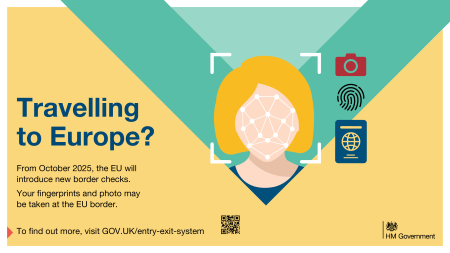
All UK travellers, including under-18s, must register their fingerprints and photo at the EU border, using electronic kiosks - similar to self-service check-in booths. 

  • Groups travelling to Europe by air will go through EES checks on arrival at their destination airport.
  • School groups crossing the Channel by ferry or rail will have their EES checks on departure at the Port of Dover, Eurotunnel or Eurostar terminals. 

Registration cannot be done in advance.

The system is being gradually introduced at EU borders. More information on the EES is available on GOV.UK

The new EU Entry/Exit System (EES) was introduced in October 2025 and applies to all non-EU travellers, including school groups from the UK.

  • Instead of border officials stamping passports, each traveller will have their photo and fingerprints taken using digital kiosks at the border.
  • Everyone in the group will need to complete the process, though children under 12 will not need to give fingerprints.
  • You can't register in advance, just bring your passport and travel documents as before.
  • Once registered, your passport details are stored for 3 years. On subsequent visits, your face or prints will be scanned to confirm it's you.
  • The system may also ask questions about your travel plans. Read what EES border questions to expect and help prepare your students before travel.

EES went live in October 2025 and should be fully operational, across all EU borders, by April 2026.

Until then, expect different experiences at each border crossing point. Look out for information signs advising what you need to do and follow the advice of border staff. 

The Entry/Exit System is part of a broader range of new EU border controls. See our travel checklist for EU rules on passport validity, health cards and visas.

All UK nationals and non-EU citizens travelling to the Schengen area will be required to undergo the EES biometric checks. Children and school groups are not exempt from EES checks. 

EES registration applies to groups visiting all EU countries except Ireland and Cyprus, and non-EU school trip destinations such as Iceland and Switzerland.

Please also be aware of the visa requirements for any students on your school trip who are not British nationals.

No, all passengers are required to register with the EES border system on every visit to the EU. However, children under 12 years only need to have their picture taken and will not need to provide a fingerprint.

School groups travelling by plane will use the EES machines on arrival at their destination airport.  

On arrival, groups will need to register their passport and biometric details at EES kiosks before proceeding through passport control.

The EES process will take a few minutes per person and so we will allow extra time for your group to clear arrivals and resume your onward journey.

School groups crossing into France via Dover, Eurostar or Le Shuttle must register their biometric data at EES kiosks before boarding their train or ferry. Read on for more about each crossing point:

Here's what to expect at Dover Ferry Port:

  • Your coach driver will drop off your group at the registration hall where there are 24 EES kiosks for the exclusive use of coach passengers
  • All non-EU nationals register their travel plans and biometric data at the EES kiosk, before proceeding through French border control
  • Once everyone is successfully through, reboard the coach for UK border control, in time to catch your ferry

To speed up the French border controls, we will pre-register your group with P&O. This is a new process (separate to EES) which only applies to school groups. Find out about the Fast-Track border process for school groups travelling through Dover,

Here's how the process will work at Folkestone Le Shuttle Terminal:

  • On arrival at the terminal, your group will disembark the coach and go through UK passport control
  • Then, reboard the coach and drive to the French reception area for EES registration
  • There are 5 EES booths for the exclusive use of coach groups, each is staffed to ensure that passengers are registered quickly
  • After passing through French passport control, your group then reboards the coach for Le Shuttle

School trips via St Pancras International

  • 50 kiosks have been installed at the station for people to register their biometrics
  • After registering your details, passengers can proceed through UK and French border controls in time to catch the train 
  • Eurostar expects registration to be quick and easy


While the system removes the need for manual passport stamps, groups travelling through the Port of Dover and the Eurotunnel Terminal at Folkestone should allow extra time to register their biometrics for the first time. We will make an allowance in your itinerary for your group to register before boarding the ferry or Le Shuttle.

The following measures have been introduced to minimise disruption for groups:

  • Dover and Folkestone have introduced dedicated lanes and separate EES registration halls just for coaches, meaning you won't be stuck behind car passengers.
  • Dover has a new fast-track border process just for school groups - we will pre-register your passengers with the French authorities to reduce passport checks at Dover. Read about the special fast-track border process for school groups here.  
  • All the EES booths at Folkestone are staffed to help passengers complete their registration.

Yes, passengers are required to visit the EES kiosks on every visit to continental Europe.

Once you have registered with EES, your details will be saved for three years, meaning a slightly quicker process for subsequent visits. The electronic process also replaces the need for travellers to have their passports stamped at the border. 

Use the table below to understand the main differences and when they come into force:


EES

(Entry / Exit System)


ETIAS

(Electronic Travel Info & Authorisation System)


ETA 

(Electronic Travel Authorisation)


Purpose


Registers the details of non-EU citizens to track their entry & exit from the Schengen area


Online travel authorisation for UK passport holders visiting the EU


Digital travel authorisation for foreign nationals visiting the UK


Applies to

UK Passport Holders & Non-EU Nationals

UK Passport Holders 

Non-UK Citizens (who don't need a visa to visit)


For trips to


Most EU & Schengen countries


Most EU & Schengen countries


The UK

When in force

Phased in from October - full implementation by 10 April 2026  

Not yet live - expected end of 2027

Live

Registration / application


Register at the border


Apply online in advance


Apply online in advance


Cost


Free


20 €


£16


In a nutshell, the ETA is a digital permit required to visit the UK from abroad while the ETIAS provides online authorisation for British citizens to visit continental Europe.

The EES, on the other hand, is a system designed to register and track people travelling to and from the EU to ensure that visitors don't overstay their permitted allowance.

European Travel Information & Authorisation System (ETIAS) for school trips

The ETIAS is not yet operational.

The European Travel Information and Authorisation System (ETIAS) is an online visa waiver scheme for UK citizens, similar to ESTA in the USA.

Once in place, all non-EU passport holders, including children, will need to apply online for permission to visit the EU and Schengen countries (including Iceland and Switzerland). 

ETIAS is not required for school trips to Ireland as the UK maintains a Common Travel Area with Ireland.


ETIAS will not impact school trips in this school year.

The online travel authorisation process is due to come into force in the last quarter of 2026.

Once live, there will be a transitional period of at least six months. During this period, travellers can still enter the EU without an ETIAS (as long as they fulfil all the other entry conditions). This means that the earliest mandatory date for ETIAS is April 2027.

There will then be a further grace period of at least six months during which first-time travellers can visit the EU without an ETIAS.

We'll update party leaders as soon as firm dates are announced. Or check the official EU travel website for the latest timeline.

The ETIAS will apply to British citizens and other non-EU nationals visiting these Schengen countries:

  • All EU countries excluding Ireland and Cyprus
  • Plus the non-EU countries of Iceland, Switzerland, Norway and Lichtenstein

Also see the visa requirements for any students on your school trip who are not British nationals.

Yes. Once operational, travellers of all ages will need a ETIAS permit to take a school trip to the EU or Iceland. However, children under 18 years are exempt from any fee.

The cost of the ETIAS is expected to be €20 for adults and free for under-18s. The permit will be valid for up to three years. 

Though children are exempt from the fee, they will still need a digital ETIAS permit to travel to the EU and Iceland.

More Travel Advice for School Trips to the EU

EHICs are being replaced by GHICs. You can read about health care, passport validity and border rules in our essential guide to taking a school trip to Europe.

Travel is a little different now we've left the EU. Read our Essential Checklist for Your School Trip to Europe for a handy update on passport validity, healthcare and visas.
To travel to most EU countries your passport must: 

  • Be less than 10 years old when you travel - check the date of issue is less than 10 years before the date you enter Europe
  • Have more than 3 months left to run before you - check the expiry date is at least 3 months after the day you leave the country

Read our Essential Checklist for Your School Trip to Europe for more tips on travelling to the EU.

Yes.

We recommend that groups avoid collective passports and that students travel under their own passports where possible. You can read more about passport validity rules, EU border checks and visa requirements in our essential checklist for EU school trips.

Why choose Voyager School Travel for your school trip?

You are in specialist hands

Our team use their teaching, language & destination experience to organise trips that are not only enriching but hassle-free. Read more →

Safety assured, bonded & accredited

As assured members of the School Travel Forum & ABTA, and protected by ABTOT & ATOL, you can be sure of our high standards. Read more →

Recommended by 9/10 teachers

Trusted to organise the educational trips for over 36,000 students & teachers a year and widely recommended by teachers. Read more →

We deliver the learning

Our expert-led language programmes, with proven educational benefits, allow teachers to enjoy the trip too. Read more →

24/7 helpline & overseas support staff

Peace of mind knowing our centre managers, instructors, coach drivers & support team will look after your every need. Read more →

No hidden costs or late changes

We only offer trips we know we can deliver. We promise to be transparent with no hidden costs & no nasty surprises. Read more →

For teachers who are serious about the educational outcomes of their school trip.

Contact us